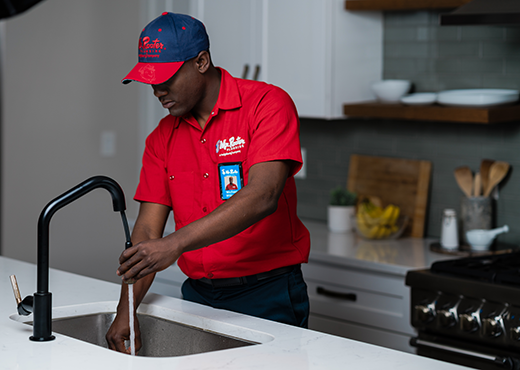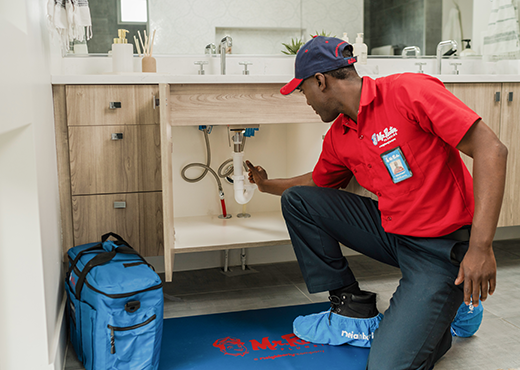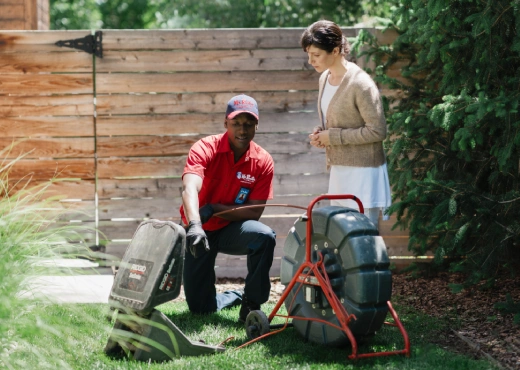

You get a pre-arrival text with your technician’s name and photo, because this job works around your foundation. We start with camera diagnostics to scope the line before any work, then hydrojet support to clear debris, roots, and buildup.
We repair or replace damaged sections when cleaning is not enough, and run a confirmation flush to verify flow. This is a known job for us, including basement-leak cases traced to a blocked line.
Signs Your Underground Downspout Drain Line Needs Attention
The trouble starts where the downspout ends and the pipe disappears underground. Most homeowners do not picture a buried drain line as the culprit, but these signs point straight to it:
- Gutters overflow during rain even after a recent cleaning. The water has nowhere to go because the underground line below is blocked.
- Downspouts gurgle or back up. Air and water are fighting a clog further down the buried pipe.
- Standing water or soggy lawn stripes appear along where the line is buried. Water is escaping a cracked or collapsed section underground.
- Water pools at the foundation or seeps into the basement after rain. The line is not carrying water away from the house like it should.
- The downspout pushes water out at ground level instead of draining underground. The inlet or buried line is clogged and the water is taking the path of least resistance.
Underground Downspout Drain Issues We Can Address
Once we know what is happening underground, here is what we typically resolve for Dayton homeowners:
- Leaf and Debris Accumulation: Years of buildup wash into the line until it chokes off flow.
- Root Intrusion: Roots from nearby trees find their way into pipe joints and seams.
- Collapsed or Bellied Sections: Ground movement and freeze-thaw cycles create low spots and breaks.
- Cracked or Broken Pipes: Aging corrugated plastic drain tiles or clay tiles can fail, causing damage.
- Sediment Buildup: Dirt and roof shingle granules settle into the line and harden over time.
Why Dayton Homeowners Need Professional Underground Downspout Repair
This is not a one-size-fits-all region, and a few local realities make these lines fail faster, including:
- Clay-Heavy Soil: Southwest Ohio’s clay soil does not drain well on its own. When an underground line fails, water saturates the soil against the foundation with nowhere to go.
- Freeze-Thaw Cycles: Dayton winters repeatedly freeze and thaw the ground around buried drain lines. That movement cracks older pipe materials and shifts the slope the line needs to drain.
- Older Homes: Many Dayton-area homes date from the 1910s through the 1970s. The corrugated plastic drain tile installed in the 1970s and 1980s is now 40 to 50 years old and failing across the metro, right alongside the original clay tile.
What Affects the Cost of Underground Downspout Drain Repair?
It’s the first question most people ask, and it’s a fair one. We won’t quote a number sight unseen, because the honest answer is that it depends on what the camera finds.
A few things shape the final cost:
- How deep the line is buried and how far it runs from the house.
- The length of the affected section and whether the whole line or just part of it needs work.
- The pipe material you have, since older clay or corrugated tile behaves differently than modern PVC.
- The repair method needed, from a straightforward cleaning to repairing or replacing a damaged section.
The best way to get a real number is a quick visit. We provide a free, upfront estimate after we see the line, present your options, and let you decide.
Contact us for an underground downspout drain line cleaning and repair estimate in Dayton.